
Wax Excipients For Tablets
About Koster Keunen
For over 170 years, Koster Keunen has been a global leader in wax manufacturing and innovation. Founded in 1852, Koster Keunen has pioneered advancements in wax technology, earning a reputation for unmatched quality, consistency, and technical expertise.
With multiple manufacturing facilities worldwide and the unique capability to support internal Disaster Recovery Planning (DRP), Koster Keunen remains the trusted partner for pharmaceutical applications, delivering solutions that meet the most stringent industry standards. All products are manufactured under GMP guidelines and produced in an SQF-certified facility.

The Role of Wax Excipients in Tablet Formulation
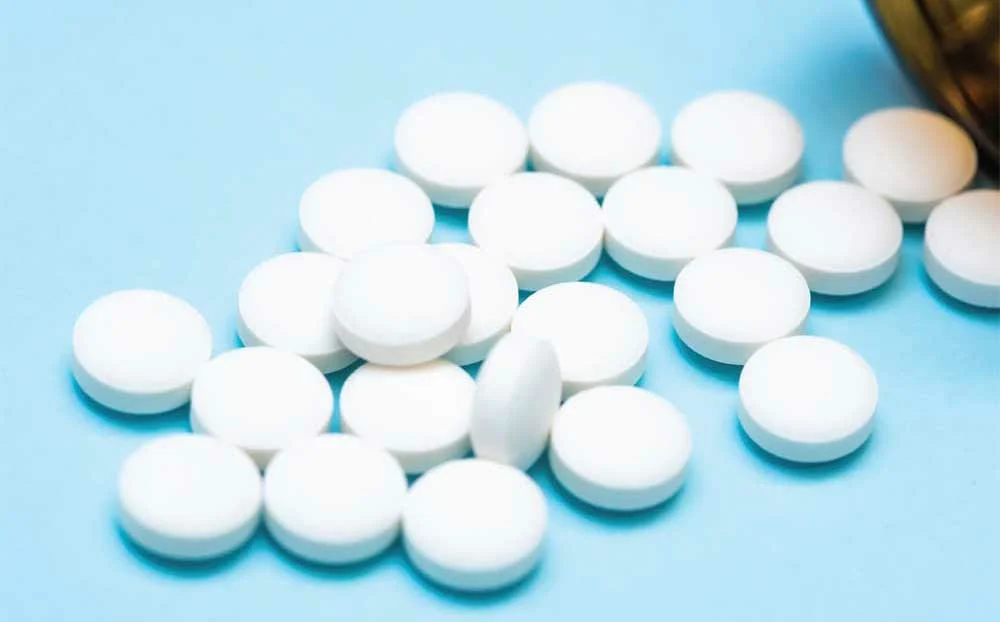
Wax excipients are essential ingredients in modern tablet manufacturing. They serve multiple critical functions across the formulation: acting as binders and release-rate modulators within the tablet matrix, providing protective coatings, improving mechanical strength, and ensuring consistent drug delivery over time.
Key functions of wax excipients in tablets include:
Controlled & Sustained Release: Wax matrices slow the diffusion of active ingredients, enabling extended therapeutic windows and improved patient compliance.
Encapsulation: Surrounds the active ingredient to protect it from the gastrointestinal environment until the desired release point.
Functional Form: Granulated wax forms are required for tablet applications, delivering consistent processing performance and reliable release results.
Higher Active Ingredient Efficiency: Wax excipients enable significantly higher active ingredient concentration with less filler, maximizing potency per tablet.
Melt Granulation: Improves flowability, compressibility, and stability of the formulation during processing.
Overcome Compression Challenges: Wax excipients support binding of difficult-to-compress actives, improving tablet integrity without negatively impacting dissolution.
Precision Dissolution Control: Wax excipients direct active ingredient release to the optimal point during ingestion, controlling where and when the active works.
Protective Coating & Polishing: Creates moisture-resistant barriers, improves swallowability, and delivers a professional tablet finish.
Reduce Tablet Size: Higher active loading enabled by wax excipients results in a significantly smaller tablet delivering the same therapeutic dose.
Tablet Binding: Wax enhances cohesion and mechanical strength, reducing chipping and friability throughout the tablet’s shelf life.
Regulatory Compliance & Quality
All Koster Keunen wax excipients for tablet applications are manufactured to the highest pharmaceutical standards:
Research Study: Wax-Encapsulated Folic Acid Dissolution
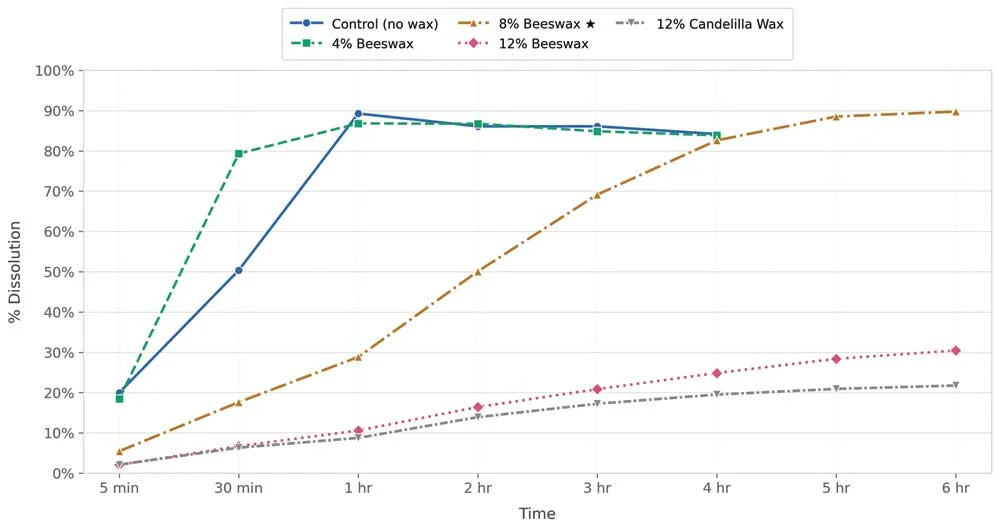
In a dissolution study conducted by CellMark Ingredients in May 2026, Koster Keunen wax excipients demonstrated powerful controlled-release performance in folic acid tablet formulations. The study was performed using Gouming RC-1 apparatus in synthetic stomach fluid (0.1N HCl at 37°C), with UHPLC analysis to track active ingredient release over 6 hours.
Study Design**
Five tablet formulations were evaluated, each containing 75% Folic Acid, with the balance comprising MCC, Mannitol, and varying levels of wax excipient:
| Sample | Formulation | Wax Level |
|---|---|---|
| Control | 75% Folic Acid, 12.5% MCC, 11.5% Mannitol, 1% Mag Stearate | None |
| Sample 2 | 75% Folic Acid, 10.5% MCC, 10.5% Mannitol | 4% Beeswax |
| Sample 3 | 75% Folic Acid, 8.5% MCC, 8.5% Mannitol | 8% Beeswax |
| Sample 4 | 75% Folic Acid, 6.5% MCC, 6.5% Mannitol | 12% Beeswax |
| Sample 5 | 75% Folic Acid, 6.5% MCC, 6.5% Mannitol | 12% Candelilla Wax |
Dissolution Results — Average Folic Acid Released (%)
| Sample | 5 min | 30 min | 1 hr | 2 hr | 3 hr | 4 hr | 5 hr | 6 hr |
|---|---|---|---|---|---|---|---|---|
| Control (no wax) | 19.97% | 50.36% | 89.27% | 86.09% | 86.10% | 84.17% | — | — |
| 4% Beeswax | 18.46% | 79.33% | 86.82% | 86.73% | 84.87% | 83.86% | — | — |
| 8% Beeswax* | 5.45% | 17.61% | 28.83% | 50.08% | 69.14% | 82.61% | 88.53% | 89.76% |
| 12% Beeswax | 2.06% | 6.71% | 10.58% | 16.42% | 20.86% | 24.86% | 28.39% | 30.45% |
| 12% Candelilla Wax | 2.11% | 6.33% | 8.75% | 13.90% | 17.24% | 19.52% | 20.92% | 21.75% |
*Recommendation: The 8% Beeswax formulation (Sample 3) is the recommended tablet excipient ratio. It achieves near-complete dissolution at 6 hours, provides low early release, and demonstrates a smooth, predictable release curve.
** Formulations and dissolution study done by CellMark Ingredients.
Higher Active Loading & Significantly Smaller Tablets
Wax excipients, specifically beeswax, enable active ingredient loading well above conventional levels — with this study demonstrating 75% loading and higher concentrations likely achievable. Substantially reduced excipient levels result in tablets that are 30–40% smaller
Key Findings
Beeswax for Tablet Applications
Beeswax is a natural, biocompatible excipient recognized as GRAS by the FDA and compliant with USP/NF standards. Its unique composition of esters, fatty acids, and hydrocarbons makes it an outstanding binding, emulsifying, and film-forming agent for tablet formulations.
Tablet Functions
Stabilizer & Release Agent: Controls drug release rate in the tablet matrix for consistent therapeutic effect.
Dose Accuracy: Improves tablet ingestion and active ingredient uniformity.
Encapsulation: Used in base mixtures to support the matrix for sustained-release tablets.
Additional Information
Natural Origin: Biocompatible, GRAS certified, sustainably harvested through responsible beekeeping.
Versatility: Effective across immediate-release, sustained-release, and enteric tablet formats.
Test Options: USP 561 for Pesticides, Chloramphenicol, Nitrofuran Metabolites, Coumaphos.
Products
| Product | Grade | Form | Wax # |
|---|---|---|---|
| Beeswax White NF | NF USP-561 | Granulated | Wax #571G |
| Beeswax Yellow NF PAC | NF PAC | Granulated | Wax #525G |
| Beeswax Yellow NF | NF USP-561 | Granulated | Wax #570G |
Carnauba Wax for Tablet Applications
Carnauba wax is a plant-derived excipient with an exceptionally high melting point and strong moisture resistance. These properties make it ideal for tablet coatings, controlled-release formulations, and specialty tablet forms
Tablet Functions
Tablet Coating & Binding: Provides a smooth, glossy finish, prevents chipping, and enhances tablet stability and shelf life.
Sustained-Release: Used in solid-dosage forms to regulate drug release and improve bioavailability.
Melt Granulation: Enhances flowability and stability of granules, supporting extended-release formulations.
Mini-Tablets: Ideal for pediatric and geriatric medications requiring precise dosing.
Barrier Protection: Shields active ingredients from moisture and environmental degradation.
Commonly used in tablets for: Acetaminophen, Aspirin, Ibuprofen, Famotidine, Omeprazole, Diphenhydramine, Hydroxyzine, Montelukast, Cyclobenzaprine, Lovastatin, Atorvastatin, and more.
Products
| Product | Form | Wax # |
|---|---|---|
| Carnauba Wax NF | Flake | Wax #420F |
| Carnauba Wax NF | Granulated | Wax #325G |
| Carnauba Wax NF | Powdered | Wax #149Q |
Candelilla Wax for Tablet Applications
Candelilla wax is a plant-derived excipient valued for its hardness, superior binding properties, and ability to enhance stability in tablet formulations. The dissolution study confirms its effectiveness as a controlled-release agent at concentration levels of 8–12%.
Tablet Functions
Tablet Binder: Improves tablet cohesion and mechanical strength, reducing breakage and chipping.
Glazing Agent: Enhances tablet surface finish, appearance, and moisture stability.
Controlled Release: Modifies drug dissolution rates when blended with other excipients — dissolution study shows sustained protection over 6+ hours at 12%.
Products
| Product | Grade | Form | Wax # |
|---|---|---|---|
| Candelilla Wax NF | NF | Granulated | Wax #419G |
| Candelilla Wax NF | NF | Granulated | Wax#10091G |