The
MODERN CREATION
OF TEXTURE
The
MODERN CREATION
OF TEXTURE

THE ART OF BUILDING MODERN COLOR COSMETICS THROUGH STRUCTURE AND SENSORY DESIGN
THE ART OF BUILDING MODERN COLOR COSMETICS THROUGH STRUCTURE AND SENSORY DESIGN
By Jessica Dynda
The Consumer Shift Toward Texture-Led Beauty
Color cosmetic innovation has shifted far beyond shade expansion and long-wear claims. While they remain essential, today’s consumers expect products that deliver a sensory experience that enhances daily beauty routines. Across color cosmetics, a tactile and sensorial quality has become a key differentiator and an increasingly important driver of product perception.
Consumers expect products that deliver color and wear, while also gliding effortlessly and being comfortable on the skin. As innovation shifts, formulators are challenged to balance pigment, performance, comfort, flexibility and texture in equal measure. Nearly every emerging trend points toward products that are softer, more tactile, more comforting, more intuitive to apply, and increasingly texture-driven. Rather than relying solely on bold pigment or dramatic transformation, brands are creating emotional connections through texture, tactility, softness, and comfort.

Market Trends for The Future
The following lasting market shifts are influencing the way formulators approach texture and sensory design in color cosmetics.
Texture Has Become as Important as Color
Consumers are increasingly drawn to products that deliver a distinct sensory experience through application and wear. Modern launches emphasize textures that melt, glide, cushion, blur, bounce, and adapt to the skin. Innovation is no longer driven solely by shade expansion, long-wear claims, or color payoff. Texture itself has become a source of differentiation. For formulators, texture is no longer a supporting characteristic. It is often the product experience itself.
This shift is driving the growth of texture-led product formats, where the physical experience plays an equally important role as color performance. Flowable anhydrous gels, soft anhydrous creams, hybrid balm systems, structured sticks, butter textures, and serum-gel hybrids are redefining consumer expectations across color cosmetics. Creating these next-generation formats requires a careful balance of structure, flexibility, sensory attributes, and stability, transforming texture design into a critical element of product development and brand differentiation.
Skin Health as the New Color Standard
The lines between skincare and color cosmetics continue to blur. Consumers increasingly expect makeup products to deliver comfort, flexibility, hydration, and skin-friendly performance alongside color benefits. Rather than masking the skin, many modern products are designed to enhance it. This trend places increasing emphasis on texture systems that feel breathable, flexible, offer blemish conscious and comfortable throughout wear
Modern consumers want products that meet them where they are.
The SPF & Color Meet-Cute
Color cosmetics and sun protection are having a moment. What was once a formulation afterthought is now a full-blown romance, with consumers searching for protective benefits alongside cosmetic performance. Successful protective color cosmetics must balance structure, stability, lightweight wear, and sensory elegance, proving that protection and prettiness can absolutely coexist.
From a formulation standpoint, this requires careful management of UV filter compatibility, emulsion stability, and film-forming systems that maintain SPF efficacy without compromising spreadability or wear. Achieving an even, non-whitening finish while keeping the filter matrix stable under heat, humidity, and movement remains one of the more demanding technical challenges in this category. Formulators will find stability and film flexibility to be critical for a successful SPF formula.
The Multifunctional Beauty Movement
Consumers continue to seek products that provide multiple benefits through fewer steps. As beauty routines become more streamlined, multifunctional formats are gaining importance across every category, from multi-sticks and balm sticks to concealer sticks, foundation sticks, hybrid complexion products, and tinted balms. These versatile formats are designed to simplify application while delivering multiple performance benefits, making texture architecture increasingly important. Success depends on creating textures that balance payoff, application, stability, and ease of use, allowing products to feel intuitive, efficient, and adaptable to modern beauty routines.
Redefining Performance: Sensory Design
Performance is being redefined. Consumers increasingly associate product quality with how a formula feels during application, not just how it functions. Attributes such as cushion, glide, creaminess, melt, richness, and payoff have become important indicators of perceived performance. As a result, product development will need to place a greater emphasis on designing textures that deliver both technical performance and emotional engagement, treating sensory experience not as an afterthought but as a defining measure of quality.
Beauty on Your Terms
Modern consumers want products that meet them where they are. Blendability, flexible coverage, compatibility with multiple application methods, and skin-like finishes have become essential formulation objectives, fueling the rise of soft-focus complexion products, buildable coverage systems, blendable cream textures, and multi-use color formats. Success now depends on textures that work with the consumer, not against them.
UNDERSTANDING FORMULATION ARCHITECTURE
Modern texture design begins with understanding the functional role of each ingredient within a formula. While individual chemistries contribute specific properties, successful systems are built through the interaction of multiple functions working together to create the desired texture, stability, and performance profile.
A well designed color cosmetic system typically balances:
- Structure
- Suspension
- Stability
- Payoff
- Spreadability
- Performance
- Texture Development
Understanding how waxes, esters, powders, and plasticizers interact allows formulators to engineer the textures they desire.
FORMULATION ARCHITECTURE
Structure
Texture Development
Plasticity
Stability
Performance

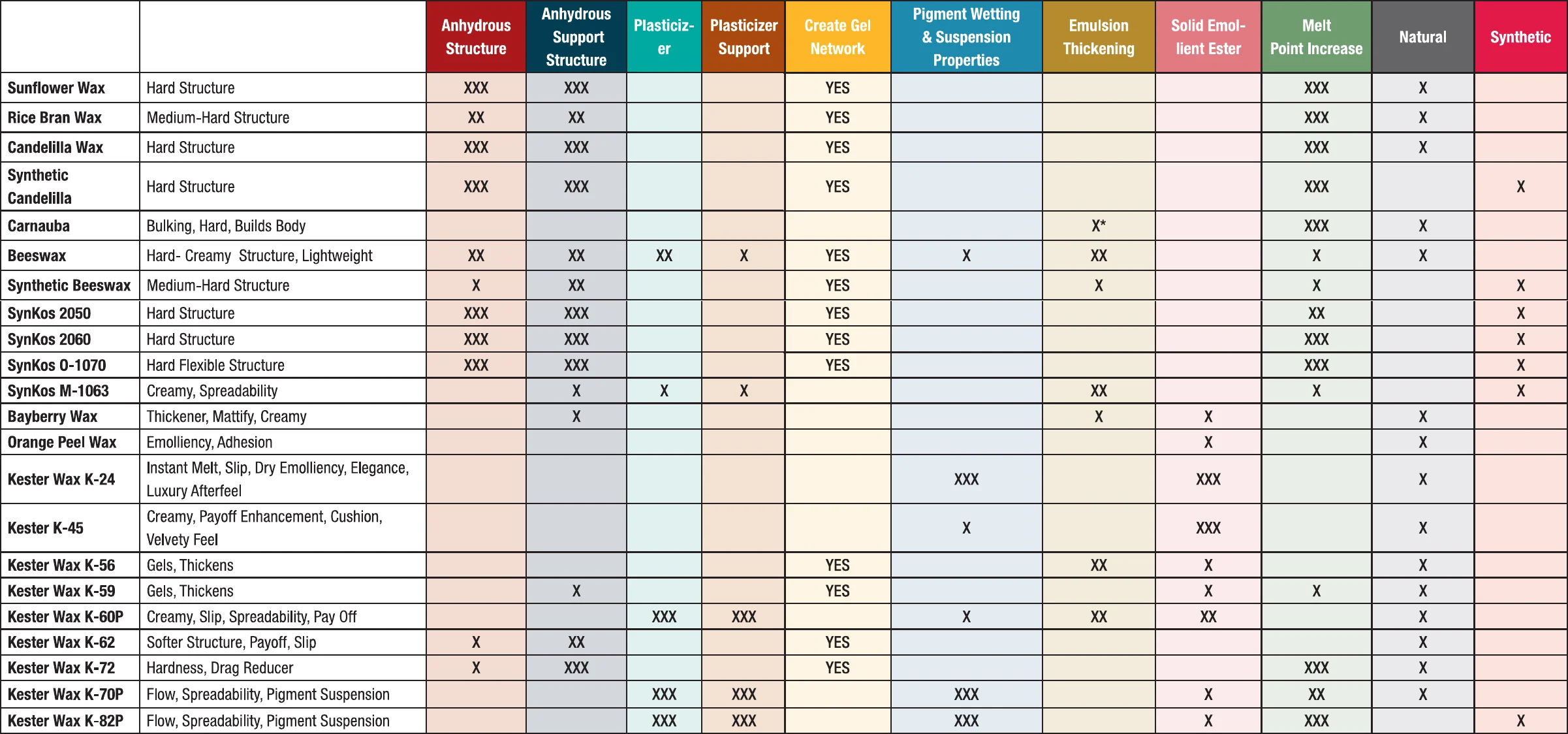
INGREDIENT FUNCTION MAP
Ratings range from one to three X’s, indicating increasing suitability for a given function. An ingredient without an X is generally not considered a preferred choice for that specific role.
Click to Enlarge
Note: The technologies referenced in this chart focus on oil-in-water emulsion systems. Koster Keunen also offers technologies specifically designed for water-in-oil (W/O) thickening and structuring, which are not included in this guide. Please contact Koster Keunen for additional information on water-in-oil texture and structuring solutions.
UNDERSTANDING TEXTURE FUNCTIONS
Modern color cosmetic textures are created by combining ingredients that perform different structural and sensory roles. Some ingredients build the backbone of a formula, while others enhance texture, improve stability, refine sensory properties, or control crystallization. Building structure is easy. Building structure that feels beautiful is where formulation excellence begins. The chart on the next page organizes Koster Keunen technologies by their primary functional contribution within a system. Ratings range from one to three X’s, indicating increasing suitability for a given function. An ingredient without an X is generally not considered a preferred choice for that specific role.
Texture Development
Texture development ingredients listed in the chart can define the sensory profile of a formula. These materials influence attributes such as creaminess, cushion, structure, glide, slip, spreadability, payoff, richness, melt, adhesion, velvety feel, and overall sensory aesthetics. While they may also contribute to structure, stability, or other functional benefits, their primary purpose is to create the desired texture experience within the finished product.
The texture descriptions provided in the chart represent the dominant sensory contribution of each chemistry and serve as a practical guide for formulation design. By carefully selecting and combining these technologies, formulators can engineer textures ranging from lightweight and elegant to rich, creamy, cushiony, or highly structured while maintaining the desired balance of performance and stability.
Plasticizers
Plasticizers are multifunctional formulation tools that do far more than improve flexibility within a wax system. They play a critical role in controlling crystallization, maintaining texture consistency, enhancing product stability, and improving overall sensory performance. By reducing brittleness and promoting plasticity, plasticizers help create creamier textures, increased cushion, improved payoff, enhanced flow, and better spreadability across a wide range of color cosmetic formats.
They can prevent graininess caused by crystal growth or ingredient migration, stop seeding in butter-rich systems, minimize bloom and syneresis, improve thermal stability, increase melt point, and support consistency from laboratory development through commercial production. Plasticizers also promote pigment, color, and SPF distribution, improve film formation, support compatibility in complex systems, and help maintain desired texture and performance throughout the product lifecycle. In modern color cosmetics, plasticizers are often essential tools for balancing structure, stability, sensory attributes, and long-term product quality.
Emulsion Thickening
Emulsion thickening ingredients increase body, consistency, and richness in oil-in-water (O/W) emulsified systems. Unlike primary structurants for anhydrous systems, these materials build viscosity, improve cream aesthetics, and enhance sensory properties through influencing the crystallinity of the emulsions internal oil phase without necessarily creating rigid or highly structured products. They are commonly used to improve texture, perceived richness, stability, and overall sensory performance in creams, lotions, complexion products, and other emulsified color cosmetic systems.
Plasticizer Support
Some ingredients naturally contribute flexibility, texture stability, and crystallization control as part of their overall functionality. These chemistries can help soften wax networks, improve payoff, reduce brittleness, support thermal stability, and maintain long-term texture consistency. While their contribution varies by chemistry, any ingredient identified in this category provides some degree of plasticizer-like performance within the system. Dedicated plasticizers deliver the strongest impact, while other materials may provide secondary support that enhances overall formulation robustness.
Anhydrous Structure
These materials form the structural backbone of anhydrous systems ranging from pot balms and cream products to sticks and pencils. Their primary function is to build structure, hardness, and shape retention while creating the framework upon which the rest of the texture is built.
Create Gel Network
Gelling ingredients create a three-dimensional network within oils and esters that provides structure and suspension. These materials transform liquid phases into structured systems ranging from flowable gels to highly structured sticks, depending on concentration and formulation design.
Solid Emollient Ester
Solid emollient esters provide many of the sensory benefits of liquid emollients while contributing additional body and texture. They are often used to improve glide, enhance spreadability, reduce greasiness, and create luxurious after-feel without sacrificing formulation stability. In addition to their sensory benefits, emollients help smooth and condition the skin by filling microscopic gaps between skin cells, supporting a softer feel and helping to reduce moisture loss
Anhydrous Support Structure
Support structure ingredients reinforce and refine primary wax networks. Rather than serving as the foundation of the system, they support the system overall, optimize payoff, adjust hardness, and help fine-tune the overall texture profile. These materials are often used in conjunction with primary structurants to achieve a more balanced sensory experience.
Pigment Wetting & Suspension Properties
These ingredients support uniform pigment distribution and help maintain stable dispersions over time. They can improve color consistency, reduce settling, enhance suspension, and contribute to more uniform payoff throughout the life of a product.
Melt Point Increase
These ingredients are used when additional thermal stability or higher temperature resistance is required. By increasing the overall melting profile of a formula, they help improve product robustness, shipping stability, and physical integrity in demanding environments
Designing Texture Through Ratio and Process
One of the most common formulation misconceptions is that softer textures require less structure. In reality, successful soft textures still require a well-developed structural network to provide thermal stability, suspension, consistency, and long-term product integrity.
Rather than removing high melting point structurants to soften a formula, formulators can modify the relationship between structurants and plasticizers to achieve the desired texture while preserving the benefits of a strong wax network. This approach allows a system to maintain its structural framework while becoming softer, more flexible, and more spreadable.
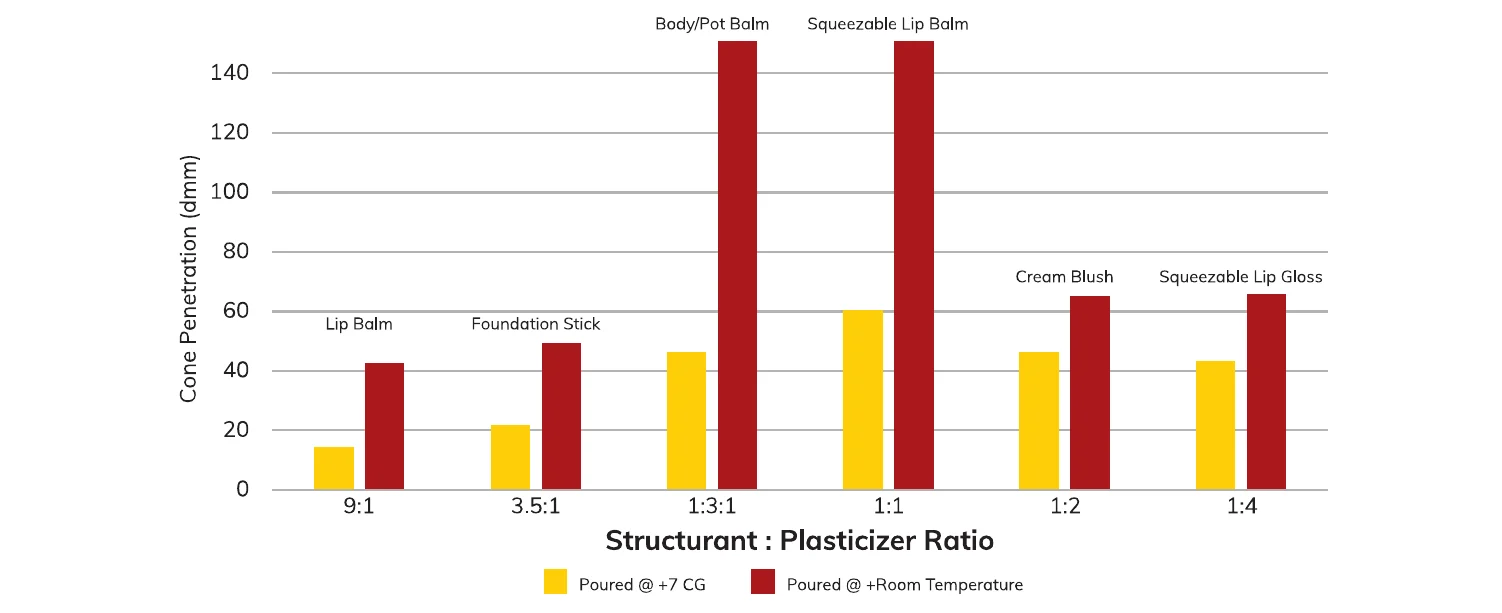
The charts below illustrate how changing the structurant-to-plasticizer ratio can dramatically alter texture, transforming a system from a structured stick to a soft balm, cream product, or squeezable format. The data demonstrates that soft and flowable textures
are not the result of eliminating structure, but rather balancing structure and plasticity within the same formulation architecture.
Processing conditions further influence the final texture. For optimal structure development, formulations are typically poured approximately 7-10°C above their congeal point, allowing the structured network to develop in a controlled manner during cooling. The data illustrates that identical structurant-to-plasticizer ratios can produce significantly different penetration values depending on processing conditions. Pouring at room temperature generally results in softer textures, while controlled pouring above the congeal point promotes stronger network formation and improved structural integrity.
Together, formulation architecture and processing conditions allow chemists to design textures ranging from foundation sticks and lip balms to body balms, cream blushes, squeezable lip balms, and flowable gloss systems without sacrificing the stability benefits provided by a structured wax network.
Key Formulation Principle
Do not remove structure to create softness. Maintain the structural network and adjust the structurant-to-plasticizer ratio to achieve the desired texture.
FORMULA TEXTURES IN PRACTICE
The following prototype formulations illustrate how changes in structure, texture development, plasticization, and processing can be used to create a wide range of sensory profiles, from lightweight oils and glosses to highly structured sticks and pencils.
Texture: Lightweight Anhydrous Oil
Inspired by the continued popularity of K-Beauty lip products, Seoul Glow Tinted Lip Oil delivers a lightweight, glossy texture that glides effortlessly across the lips. This nourishing anhydrous formula provides buildable color, hydration, and shine while maintaining a comfortable feel that never feels heavy or sticky. Natural-focused ingredients support a modern sensorial experience with a sheer, stain-like finish.
Texture: Structured SPF Balm
Combining color, glow, and sun protection, Dewy Glow SPF Balm highlights the convergence of cosmetics and protective skincare. This vegan formula delivers a buildable dewy finish while providing SPF benefits, allowing consumers to apply a sheer wash of color or layer for greater impact on the lips, eyes, and cheeks.
Texture: Soft Anhydrous Balm
This smooth, lightweight primer demonstrates how an anhydrous system can achieve excellent pickup and flexibility while maintaining stability. Designed to promote smooth, crease-resistant eyeshadow application, the chassis can easily be adapted into a color-correcting concealer or wand format through simple adjustments to the structurant-to-plasticizer ratio.
Texture: Creamy Anhydrous High-Pigment Highlighter
A creamy, multi-use highlighter featuring a rosy-pink shimmer and a smooth melt-into-skin application. The balanced structure delivers excellent payoff while maintaining a lightweight, radiant finish suitable for face and body. This versatile chassis can easily be adapted for cream-to-pot or wand applications while maintaining the same sensory profile and visual effect.
Texture: Viscous Oil-in-Water Emulsion
Botanica Lash is a flexible oil-in-water mascara designed to lengthen, define, and separate lashes. The emulsion system provides excellent customization opportunities while delivering a viscosity profile compatible with a wide range of brush designs. The formula serves as a versatile platform for developing mascaras with different performance and aesthetic targets.
Texture: Squeezable Anhydrous Gloss
The perfect lip gloss, Glaze Craze Lip Gloss provides a rich, cushiony texture with brilliant shine and suspended shimmer. This soft, conditioning formula enhances the lips with a hint of color while delivering the high-gloss appearance consumers continue to seek in modern lip products
Texture: Creamy Water-in-Oil Stick
This travel-friendly multipurpose stick showcases the benefits of water-in-oil technology in color cosmetics. Delivering medium coverage with a dewy finish, Total Tint glides onto the skin, blends seamlessly, and can be used across multiple application areas. Its creamy texture demonstrates the balance of structure, flexibility, and payoff required in modern hybrid stick formats.
Texture: Squeezable Anhydrous Gloss
The perfect lip gloss, Glaze Craze Lip Gloss provides a rich, cushiony texture with brilliant shine and suspended shimmer. This soft, conditioning formula enhances the lips with a hint of color while delivering the high-gloss appearance consumers continue to seek in modern lip products
BRINGING TEXTURE TO LIFE
Texture is no longer simply a formulation parameter—it has become a primary driver of product perception, consumer experience, and product performance.
The modern creation of texture requires formulators to strategically balance structure, flexibility, stability, and sensory design. By understanding how waxes, esters, plasticizers, and gelling technologies interact within a formulation, it becomes possible to engineer products that not only perform exceptionally but also create the emotional and tactile experiences consumers increasingly seek.
From flowable gels and soft creams to high-performance sticks and balms, the future of color cosmetics will be defined not only by color, but by the textures that bring those products to life.
Formula: #6/26-10092/10098-6
FEATURES
- A lightweight lip tint that glides on smooth with buildable color
- Nourishing and hydrating
- Natural Ingredient focused
Color Cosmetics
Anhydrous
Clean/Natural
| Ingredient Trade Name | INCI Name | % |
| Phase A | ||
| Kester Wax K-70P | C18-38 Alkyl Hydroxystearoyl Stearate | 7.0 |
| Kester K-45 | Jojoba Esters | 7.0 |
| Kester Wax K-62 | Stearyl Behenate | 1.0 |
| Bayberry Wax | Myrica Cerifera (Bayberry) Wax | 0.2 |
| Castor Oil | Ricinus Communis (Castor) Seed Oil | 29.0 |
| Sunflower Oil | Helianthus Annuus (Sunflower) Seed Oil | 20.0 |
| Almond Oil | Prunus Amygdalus Dulcis (Sweet Almond) Oil | 15.8 |
| Jojoba Oil | Simmondsia Chinensis (Jojoba) Seed Oil | 16.0 |
| Phase B | ||
| SynCrystal Very Berry | Synthetic Fluorphlogopite (and) Iron Oxides (and) Titanium Dioxide | 2.0 |
| Sudacos Rubine 3054 | D&C Red 7 lake | 2.0 |
Procedure
- Combine Phase A ingredients, mix and melt at 85°C until uniform
- Add Phase B and mix well, homogenize if necessary
- Continue to mix while cooling to room temperature
- Pump into containers
Formula: #7/26-258/224/358-2
FEATURES
- Get SPF protection along with a dewy glow
- Vegan formula
- Apply lightly to eyes, cheeks, or lips for a sheer hint of color or layer for more of a pop of color
Skin Care
Anhydrous
Traditional Ingredients
| Ingredient Trade Name | INCI Name | % |
| Phase A | ||
| Sunflower Wax | Helianthus Annuus (Sunflower) Seed Wax | 14.0 |
| Rice Bran Wax (Wax# 224) | Oryza Sativa (Rice) Bran Wax | 8.0 |
| Kester Wax K-60P | Polyhydroxystearic Acid | 4.0 |
| Kester Wax K-24 | Lauryl Laurate | 8.0 |
| Kester Wax K-45 | Jojoba Esters | 1.0 |
| Parsol HMS | Homosalate | 10.0 |
| Parsol 340 | Octocrylene | 10.0 |
| Parsol 1789 | Butyl Methoxydibenzylmethane | 3.0 |
| Parsol EHS | Ethylhexyl Salicylate | 5.0 |
| Jeechem TN | C12-C15 Alkyl Benzoate | 10.0 |
| Jeechem CTG | Caprylic/Capric Triglyceride | 10.0 |
| Solvience DCC | Dicaprylyl Carbonate | 16.0 |
| Vitamin E Acetate | Vitamin E Acetate | 0.5 |
| Sudacos Cherry 3061 | D&C Red 6 Lake | 0.2 |
| Prestige Silk Silver | Mica (and) Titanium Dioxide | 0.3 |
Procedure
- Combine all Phase A ingredients
- Melt at 80-85°C and mix until uniform, using shear if necessary
- Pour into containers around 85°C
- Allow to cool to room temperature
Formula: #6/26-10098/10092/858-12
FEATURES
- Buildable color-correcting formula
- Neutralizes redness and soothes skin
- For all skin types
Color Cosmetics
Anhydrous
Traditional Ingredients
| Ingredient Trade Name | INCI Name | % |
| Phase A | ||
| Kester Wax K-70P | C18-38 Alkyl Hydroxystearoyl Stearate | 9.0 |
| Kester K-45 | Jojoba Esters | 10.0 |
| Synkos 2050 | Synthetic Wax | 4.0 |
| Bayberry Wax | Myrica Cerifera (Bayberry) Wax | 2.0 |
| Dermol DISM | Diisostearyl Malate | 9.5 |
| Lipovol Crambe | Crambe Abyssinica Seed Oil | 11.0 |
| Ganex V-220F | VP/Eicosene Copolymer | 2.0 |
| LL-0061 Lauroyl Lysine Treated Sericite | Mica (and) Lauroyl Lysine | 4.0 |
| Sericite | Mica | 25.6 |
| Titanium Dioxide 325 | Titanium Dioxide | 1.68 |
| Sipernat 11 PC | Hydrated Silica | 3.0 |
| Unipure Green LC 788 | Iron Oxides CI 77288 | 0.21 |
| Unipure Yellow LC 182 | Iron Oxides CI 77492 | 0.01 |
| Phase B | ||
| Purolan IDD | Isododecane | 18.0 |
Procedure
- Combine all Phase A ingredients
- Melt at 80-85°C and mix until uniform, using shear if necessary
- Add Phase B and mix while cooling
- Cool until 50-55°C and pump into containers
Formula: #2/26-224/358/10098-13
FEATURES
- Highlighter with light smooth application.
- Multi Purpose & Travel Friendly
- Creamy, Blendable Formula
Color Cosmetics
Anhydrous
Clean/Natural
| Ingredient Trade Name | INCI Name | % |
| Phase A | ||
| Rice Bran Wax (Wax# 224) | Oryza Sativa (Rice) Bran Wax | 3.0 |
| Kester Wax K-70P | C18-38 Alkyl Hydroxystearoyl Stearate | 8.5 |
| Kester K-45 | Jojoba Esters | 12.5 |
| Kester K-24 | Lauryl Laurate | 12.5 |
| Cetiol CC | Dicaprylyl Carbonate | 19.5 |
| Olive Squalane | Squalane | 6.5 |
| Jojoba Oil | Simmondsia Chinensis (Jojoba) Seed Oil | 6.5 |
| Sumicos Iridescent Pink | Mica (and) Titanium dioxide | 8.5 |
| Prestige Ruby | Mica (and) Titanium Dioxide (and) Carmine (and) Tin Oxide | 1.0 |
| Sumicos Polar Mist | Titanium dioxide | 4.5 |
| Sericite | Mica | 12.0 |
| Phase B | ||
| Vegelite 1214LC | Coconut Alkanes (and) Coco-Caprylate/Caprate | 5.0 |
Procedure
- Combine Phase A ingredients, mix and melt at 85°C until uniform
- Add Phase B and mix well
- Once homogeneous, pour into containers around 60-65°C
- Cool to room temperature
Formula: #6/26-258/224/10098-2
FEATURES
- Creamy and smooth consistency that glides on skin
- Melts into the skin with a radiant finish
- Adds a dewy glow to the complexion
Color Cosmetics
Anhydrous
Clean/Natural
| Ingredient Trade Name | INCI Name | % |
| Phase A | ||
| Sunflower Wax | Helianthus Annuus (Sunflower) Seed Wax | 6.0 |
| Rice Bran Wax (Wax# 224) | Oryza Sativa (Rice) Bran Wax | 4.0 |
| Kester Wax K-70P | C18-38 Alkyl Hydroxystearoyl Stearate | 4.0 |
| Kester K-45 | Jojoba Esters | 4.0 |
| Bayberry Wax | Myrica Cerifera (Bayberry) Wax | 3.0 |
| Castor Oil | Ricinus Communis (Castor) Seed Oil | 24.0 |
| Jeechem CTG | Caprylic/Capric Triglyceride | 13.0 |
| Olive Squalane | Squalane | 4.0 |
| Sumicos Iridescent Pink | Mica (and) Titanium dioxide | 7.9 |
| Prestige Ruby | Mica (and) Titanium Dioxide (and) Carmine (and) Tin Oxide | 0.9 |
| Sumicos Polar Mist | Titanium dioxide | 4.2 |
| Mica Sericite BC 285 | Mica | 15.0 |
| Phase B | ||
| Vegelite 1214LC | Coconut Alkanes (and) Coco-Caprylate/Caprate | 10.0 |
Procedure
- Combine Phase A ingredients, mix and melt at 85°C until uniform
- Add Phase B and mix well
- Once homogeneous, pour into containers around 80-85°C
- Cool to room temperature
Formula: #6/26-358/10092/421-3
FEATURES
- Softens and conditions lips
- Leaves a hint of color and brilliant shine
- Uses natural ingredients
Color Cosmetics
Anhydrous
Clean/Natural
| Ingredient Trade Name | INCI Name | % |
| Phase A | ||
| Kester Wax K-70P | C18-38 Alkyl Hydroxystearoyl Stearate | 20.0 |
| Kester Wax K-24 | Lauryl Laurate | 5.0 |
| Kester K-45 | Jojoba Esters | 4.0 |
| Castor Oil | Ricinus Communis (Castor) Seed Oil | 34.5 |
| Jeechem CTG | Caprylic/Capric Triglyceride | 23.3 |
| Jojoba Oil | Simmondsia Chinensis (Jojoba) Seed Oil | 12.0 |
| Prestige Pearly Almond | Mica (and) Titanium Dioxide (and) Iron Oxides (and) Tin Oxide | 0.25 |
| Prestige Soft Fire Red Mica (and) Iron Oxide 0.50 | Mica (and) Iron Oxide | 0.5 |
| Prestige Silk Silver | Mica (and) Titanium Dioxide | 0.45 |
Procedure
- Combine all ingredients
- Melt at 80-85°C and mix until uniform
- Continue to mix while cooling to 70°C
- Pour into containers
Formula: #6/26-10089/358/883-1
FEATURES
- Multi Purpose & Travel Friendly
- Medium Coverage with Dewy Finish
- Creamy, Blendable Formula
Color Cosmetics
Emulsion
Traditional Ingredients
| Ingredient Trade Name | INCI Name | % |
| Phase A | ||
| Synkos O-1070 | Synthetic Wax | 4.2 |
| Synkos 2060 | Synthetic Wax | 7.0 |
| Kester Wax K-24 | Lauryl Laurate | 4.2 |
| Dow ES 5300 | Lauryl PEG-10 Tris(Trimethylsiloxy)silylethyl Dimethicone | 3.0 |
| BELSIL DM 1 Plus | Dimethicone | 19.5 |
| Olive Squalane | Squalane | 7.1 |
| Zinc Stearate USP | Zinc Stearate | 0.5 |
| Unipure White LC-987 AS-EM | CI 77891 (and) Triethoxycaprylylsilane | 3.19 |
| Unipure Red LC-381 AS-EM | CI 77491 (and) Triethoxycaprylylsilane | 0.06 |
| Unipure Yellow LC-182 AS-EM | CI 77492 (and) Triethoxycaprylylsilane | 0.45 |
| Unipure Triple Black LC990 AS-EM | CI 77499 (and) Triethoxycaprylylsilane | 0.04 |
| Phase B | ||
| Deionized Water | Aqua | 45.76 |
| Glycerin | Glycerin | 3.0 |
| Optiphen | Phenoxyethanol, Caprylyl Glycol | 1.0 |
| Magnesium Sulfate | Magnesium Sulfate | 1.0 |
Procedure
- Combine Phase A ingredients and heat to 85-90°C
- Combine Phase B ingredients and heat to 85-90°C
- Once both Phases are at temperature, add
- Phase B to Phase A and increase mixing speed, homogenizing if necessary
- Continue to mix while cooling to 84°C
- Pour into containers
Formula: #6/26-883/10093/154-6
FEATURES
- Creamy, blendable eyeliner
- Easy glide on Formula
- Vegan
Color Cosmetics
Anhydrous
Traditional Ingredients
| Ingredient Trade Name | INCI Name | % |
| Phase A | ||
| Synkos 2060 | Synthetic Wax | 29.0 |
| Synkos M-1063 | Synthetic Wax | 7.0 |
| Kester Wax K-82P | C18-38 Alkyl Hydroxystearoyl Stearate | 1.0 |
| Sericite | Mica | 9.0 |
| Dermol DISM | Diisostearyl Malate | 10.0 |
| SonneNatural Fluidity 40P | C15-19 Alkane | 13.0 |
| Phase B | ||
| Unipure Red LC 3075 | Iron Oxides CI 15850 (and) Aluminum Hydroxide | 10.38 |
| Unipure Black LC 989 | Iron Oxides CI77499 | 5.89 |
| Unipire Yellow LC182 Iron Oxides CI 77492 1.24 | Iron Oxides CI 77492 | 1.24 |
| Jeechem CTG | Caprylic/Capric Triglyceride | 13.49 |
Procedure
- Combine Phase B ingredients and mill until homogeneous
- Combine Phase A ingredients in a vessel, heat and mix until uniform
- Add Phase B to Phase A and mix
- Pour into containers at around 85°C, allow to cool to room temperature
Formula: #12/25-224/122-3
FEATURES
- Lengthens and defines lashes.
- Flexible formula for personalization
- Viscous formula for many brush options
Color Cosmetics
Emulsion
Traditional Ingredients
| Ingredient Trade Name | INCI Name | % |
| Phase A | ||
| Deionized Water | Aqua | 55.25 |
| Butylene Glycol | Butylene Glycol | 3.0 |
| Solagum AX | Acacia Senegal Gum (and) Xanthan Gum | 1.0 |
| CELL-U-LASH 150 | Cellulose | 1.0 |
| Tealan 99 | Triethanolamine | 0.75 |
| Phase B | ||
| Kostol Natural E | Behenyl Alcohol, Polyglyceryl-3 Stearate | 3.0 |
| Synthetic Beeswax 122 | Synthetic Beeswax | 6.0 |
| Rice Bran Wax (Wax# 224) | Oryza Sativa (Rice) Bran Wax | 3.0 |
| Kester Wax K-70P | C18-38 Alkyl Hydroxystearoyl Stearate | 2.0 |
| Stearic Acid 92% | Stearic Acid | 2.0 |
| Indopol H-100 | Polyisobutene | 4.0 |
| Ganex V-220F | VP/Eicosene Copolymer | 2.0 |
| Vitamin E Acetate | Tocopheryl Acetate | 1.0 |
| Unipure Triple Black LC 990 | Iron Oxides CI 77499 | 11.0 |
| Phase C | ||
| Lincoserve WpH-LO | Pentylene Glycol (and) Caprylyl Glycol (and) Propanediol (and) Ethylhexylglycerin | 1.0 |
| NatPure Film AP | Pullulan (and) Sorbitol (and) Trehalose (and) Acacia Senegal Gum | 4.0 |
Procedure
- Combine Phase A ingredients, mix and heat to 80-85°C
- Mix and melt Phase B materials, except for the pigment. Once the materials are melted, slowly add the pigment and mix
- Once both Phases are at homogeneous and at temperature, add Phase B to A and increase mixing speed
- Mix at high speed until emulsion is smooth, then cool with slower mixing to 60°C
- Add phase C
- Continue mixing while cooling to 50°C or lower and pump into containers

